
News Page
September 2024 meeting
Show and Tell was provided by Erwin de Raad who produced a pair of doll-sized clogs, and the following interesting information, which he has summarised for us:
Clogs—wooden shoes, were once found throughout all of Europe. From around the year 1200 onwards, people started to protect their feet, where it was common to walk on bare feet before that age. So clogs are not unique to the Netherlands. But they were very suitable for the Dutch landscape, full of swamps. Where rich city dwellers chose nice leather shoes, farmers in the Dutch countryside stuck to clogs. They are robust, safe, waterproof and, as an extra bonus, were cheaper, too. The European Union have even declared them official safety shoes! They are still the favourite footwear for farmers and gardeners, although in this day and age there is a lively trade in richly decorated clogs in various bright colours for tourists.
The designs on these painted clogs reflect the area where they are from. Inside a wooden clog people wear a thin, black leather inner which also acts as a slipper for use in doors. Clogs are made from blocks of willow or poplar wood; believe it or not, clogs are warm in winter and cool in summer. (As a young man, Erwin wore them when he dug potatoes for a farmer on an island in the north of the Netherlands. He had not worn the clogs he passed around.) Another interesting fact is that the clog dance was the forerunner of the tap dance.
Published in The Papakura Sentinel – October-November edition
Courtesy of Papakura Museum
.png)
Courtesy of Papakura Museum
Positively (eng)Aging
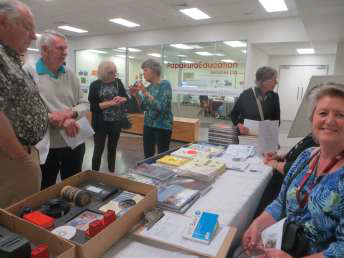
Papakura held its first Positively Aging exhibition in the Accent Point building between the Library and Museum on Thursday 14 November 2024. A good selection of groups were represented, including the Local Board which organised the event, Auckland Council, and a lot of voluntary groups which enrich the community.
As the pictures above show, a keen group of young-in heart and positively aging (dare I say that?) members, in particular our two Wendys (Deeming—behind the camera) and Gibson, Christine, and the Carsons cheerfully personed a desk with information about the Historical Society and the Museum, with books for sale, while other members looked after other organisations (we have a broad range of interests) or walked around in an encouraging and positive way. There was considerable interest.
Thanks to all who contributed. We hope this will be a regular event.
Published in The Papakura Sentinel – December-January edition

PAPAKURA MUSEUM - CURRENT AND UPCOMING EXHIBITIONS / TALKS
Visit Papakura Museum's Military Gallery (Permanent Exhibition)
25 March 2026
Explore how military history has shaped Papakura.
It is a space that sensitively uses images, words and physical objects to illustrate how the major conflicts of the last 160 years impacted on the lives of New Zealanders.
As always there is a strong emphasis on men and women from Papakura who served in the armed forces (including nurses) and those who supported the war effort from the homefront.
During the New Zealand Wars the conflict was literally in our own backyard from July to December of 1863, with skirmishes in the Hunua Ranges, the Drury Hills and areas of Franklin.
A key part of the Military Gallery is the Costar Collection; one family’s precious, physical memories of two sons that lost their lives during World War One.
New Zealand's Forgotten War Exhibition at Papakura Museum
1 May 2026
People, stories & realities of the Boer War.
A chapter of history often overlooked, but not forgotten.
This new exhibit brings forward the people, stories, and realities of the Boer War.
Come in and explore this chapter of our history.
Exhibition on Now - Aerial images of Papakura - "Before the Drone Age"
19 May 2026
Long before drones hovered over our streets and suburbs, these images captured Papakura the old-fashioned way — from aircraft, courage, and a good deal of vibration. Taken high above the town across the decades, they reveal a changing landscape of roads, railways, paddocks, and progress, preserving moments in Papakura’s story from a perspective few ever saw.
No 4 (Ardmore) Squadron - On Display Now
5 June 2026
Formed in 1958 as part of the New Zealand Air Training Corp.
Long Range Desert Group: The Kiwi Scorpions Opened Thursday 2 July
2 July 2026
Discover the remarkable story of the Long-Range Desert Group, one of the Second World War’s most legendary special forces units. Featuring artefacts generously loaned by internationally recognised Long Range Desert Group authority Brendan O’Carroll, this new exhibition brings to life the courage, endurance, and ingenuity of these extraordinary soldiers.
What She Wore Opened Saturday 11 July
11 July 2026
Travel through a century of fashion in this beautifully curated exhibition by museum volunteer Dena Gilmore. From elegant Victorian gowns to the fashions of the 1970s, What She Wore explores how clothing reflects changing lifestyles, culture, and identity. The exhibition also features three stunning garments by celebrated New Zealand designer Juliette Hogan, including one famously worn by Taylor Swift.
The Story of Papakura
10 September 2026
Explore The Story of Papakura at the Papakura Museum! Journey through an untouched land, stand with Ngā Iwi at Pukekiwiriki Pā, and join the colonial settlers as they voyage to New Zealand. Follow the footsteps of our people through colonisation, conflict, and onward…
Upcoming Talks at the Museum


PDHS is proudly supported by the Papakura Local Board